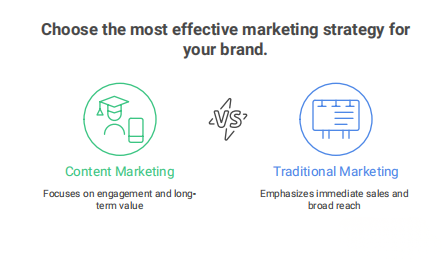
Content marketing and traditional marketing differ in their approach, goals, cost, and engagement methods, shaping how brands connect with audiences today.
1. Approach and Customer Relationship
Content Marketing: Adopts an inbound strategy, drawing customers in with valuable and relevant information. This approach aims to educate, entertain, or solve problems, positioning the brand as a trusted authority over time. Customers voluntarily engage with the content, fostering a sense of trust and loyalty.
Traditional Marketing: Employs an outbound strategy, proactively pushing promotional messages to a broad audience. This interruptive approach aims for immediate awareness or purchases, often through advertisements that may not be directly relevant to the viewer’s interests.
2. Goals
Content Marketing: Prioritizes long-term audience engagement, nurturing leads, and building strong, sustained relationships. The goal is to drive organic traffic and repeated conversions by providing consistent value and establishing a loyal customer base.
Traditional Marketing: Focuses on short-term results, such as generating immediate sales or increasing brand visibility through mass media campaigns. These campaigns often utilize channels like TV, radio, billboards, and print ads to reach a wide audience quickly.
3. Communication Style
Content Marketing: Encourages two-way communication with audiences through various channels like blogs, social media, videos, and podcasts. This interactive approach fosters engagement, allowing for comments, sharing, and direct feedback, creating a community around the brand.
Traditional Marketing: Typically involves one-way communication, where messages are broadcast without direct interaction or immediate feedback channels. The brand disseminates information without actively engaging in a dialogue with the audience.
4. Cost and ROI
Content Marketing: Generally less expensive upfront and delivers a higher return on investment (ROI) over time. It generates more leads compared to traditional marketing, and its ROI is highly measurable through digital metrics like clicks, shares, and conversions.
Traditional Marketing: Tends to be costly due to expensive ad placements and less precise targeting. Tracking ROI is challenging due to limited analytics and attribution options, making it difficult to accurately assess the effectiveness of campaigns.
5. Audience Targeting
Content Marketing: Enables highly targeted and personalized messaging based on customer interests and behaviors. Data analytics and segmentation allow brands to tailor content to specific audience segments, increasing relevance and engagement.
Traditional Marketing: Usually employs mass targeting, reaching broad audiences without fine-tuned personalization. This approach can result in wasted resources by reaching individuals who are not interested in the product or service.
6. Longevity and Impact
Content Marketing: Offers evergreen benefits, with blogs, videos, and educational content continuing to attract traffic and leads long after publication. This lasting impact provides sustained value and contributes to long-term brand growth.
Traditional Marketing: Has a shorter lifespan; once a TV or print campaign ends, so does its impact. The effects are often temporary, requiring continuous investment to maintain brand visibility.
When to Use Which?
- Use traditional marketing when aiming for wide brand exposure rapidly, launching products, or running promotions where mass reach is vital.
- Use content marketing to build sustainable, engaged audiences, improve SEO, and establish authority that drives ongoing organic growth.
In 2025, savvy brands often blend both tactics, leveraging the immediacy of traditional marketing with the relationship-building power of content marketing to maximize impact and ROI. This integrated approach allows for a comprehensive marketing strategy that addresses both short-term and long-term goals.