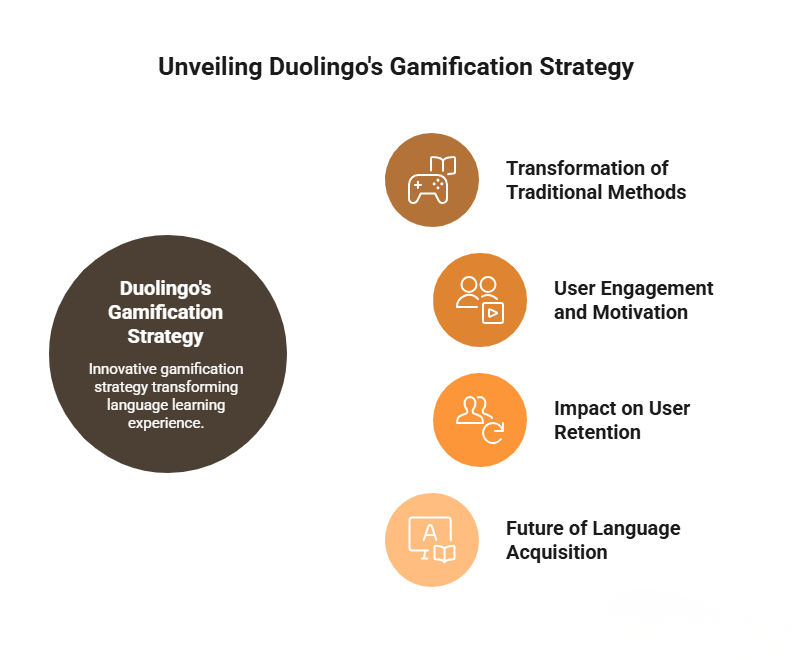
This case study analyzes Duolingo’s success by 2025, highlighting how the company’s deep integration of gamification principles and a product-led growth (PLG) strategy propelled it to global scale, exceptional user retention, and substantial monetization within the EdTech sector. The study examines the core elements of Duolingo’s gamification strategy, its PLG dynamics, execution tactics, and key performance metrics, offering insights into how other digital products can achieve sustainable and scalable growth.
Background and Challenge
Traditionally, language learning involved monotonous drills and extensive manual study, often resulting in low motivation and high dropout rates. By the second quarter of 2025, Duolingo had revolutionized this landscape, amassing 128 million monthly active users by transforming language acquisition into an engaging, game-like experience. This achievement demonstrated that a product-led growth (PLG) model, coupled with effective gamification, could effectively replace costly, ad-driven user acquisition strategies.
Gamification Strategy
Duolingo’s core engagement loops are built upon seven key pillars:
- XP Points & Streaks: The daily accumulation of experience points (XP) and the maintenance of learning streaks create self-reinforcing habits. Users become invested in preserving their streaks, motivating them to continue their daily lessons.
- Badges & Leaderboards: Achievement badges and competitive leaderboards introduce a social element, encouraging users to strive for higher rankings and unlock new badges. This competitive spirit often drives users to complete “just one more lesson.”
- Daily Quests & Timed Challenges: Themed missions and timed challenges provide variety and a sense of urgency, preventing the learning routine from becoming stale and maintaining user engagement. These challenges are designed to be manageable and rewarding.
- Virtual Rewards & Gems: Tangible-seeming rewards, such as gems and streak freezes, offer instant gratification and foster a sense of long-term investment in the platform. These rewards can be used to purchase various in-app features and benefits.
- Narrative Adventures: Story-driven lessons embed language learning within engaging narratives, fostering deeper immersion and making the learning process more enjoyable and memorable.
- AI-Personalized Challenges: Adaptive difficulty levels, powered by artificial intelligence, ensure that learners remain in the optimal “flow” zone—challenged but not overwhelmed. This personalized approach caters to individual learning styles and paces.
- Community & Social Learning: Clubs, group challenges, and branded memes foster camaraderie and accountability, strengthening habit formation and creating a supportive learning environment.
Product-Led Growth Dynamics
- Organic Acquisition: Approximately 80% of new users are acquired organically through viral loops created by gamified features and social sharing. This highlights the effectiveness of Duolingo’s PLG strategy.
- Localization and Cultural Fit: Tailored courses and marketing campaigns for specific regions, such as India, Brazil, and Mexico, ensure relevance and adoption across diverse markets. This localization strategy is crucial for global expansion.
- Data-Driven Iteration: Continuous A/B testing of UI elements, reminder tones, and feature rollouts keeps the app fresh and optimizes user retention. This iterative approach allows Duolingo to constantly improve its platform based on user feedback and data analysis.
Execution Tactics
- Cross-Platform Content: Gamified notifications, memes, and user stories on platforms like TikTok and Instagram, combined with in-app challenges and email nudges, work in concert to maintain high visibility and engagement.
- Rapid Experimentation: Duolingo deploys and evaluates hundreds of small tweaks per month, enabling swift course corrections and feature enhancements. This agile approach allows the company to quickly adapt to changing user needs and preferences.
- Community Engagement: High-profile meme campaigns featuring the Duolingo owl, along with celebratory spotlights for top learners, fuel word-of-mouth marketing and social proof.
Performance Metrics
Metric | Outcome |
|……………………………………………………………………………………………………………………… |
Monthly Active Users (MAU) | 128 million (24% YoY growth) |
Daily Active Users (DAU) | 47 million (37% DAU/MAU ratio) |
Paid Subscribers | 10.9 million (35% increase) |
Quarterly Revenue (Q2 2025) | $252 million (41% YoY growth) |
Retention Rate | 37% DAU/MAU, leading EdTech benchmark |
Organic Acquisition Rate | 80% of new users from PLG-driven viral loops |
App Store Ranking | #1 in Education on iOS & Android |
Key Takeaways
- Deep Gamification builds habit-forming loops: embed game mechanics at the core, not as add-ons.
- PLG as a Growth Engine: Design products that market themselves through shareable achievements and viral mechanics.
- Community & Localization: Social features and cultural tailoring drive relevance and sustained engagement globally.
- Continuous Data-Driven Optimization: Frequent, small experiments maintain novelty and maximize retention.
Duolingo’s 2025 model demonstrates that true gamification, when combined with PLG and relentless iteration, can propel user engagement and revenue in a competitive landscape—offering a blueprint for any digital product seeking sustainable, scalable growth.