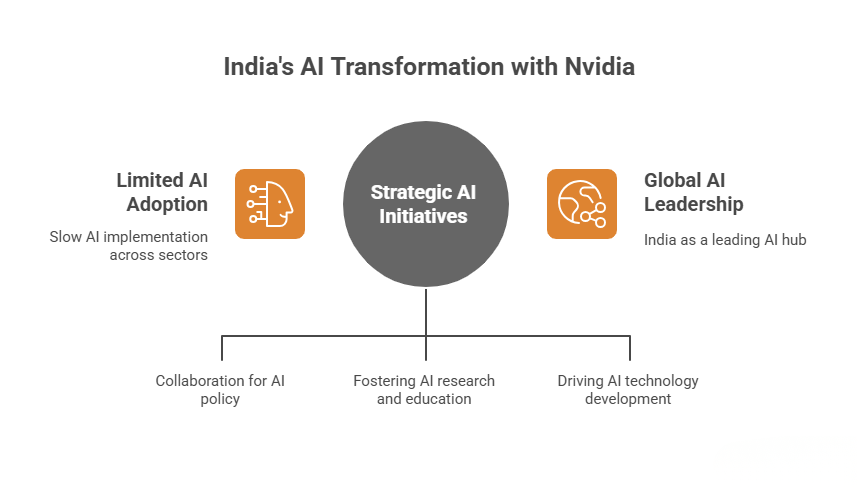
While Nvidia dominates global AI infrastructure, India has emerged as one of the company’s most strategic markets, representing both a massive growth opportunity and a critical operational hub. With India’s 1.4 billion population, rapidly digitizing economy, and world-class technical talent, Nvidia is making unprecedented investments to position India as a global AI powerhouse.
Why India Matters to Nvidia
1. StrategicPivot from China
As U.S.-China tensions curtailed Nvidia’s access to the Chinese market (historically 20-25% of revenue), India has become a critical replacement market. CEO Jensen Huang has described this as “India’s moment,” recognizing the country as the next major AI growth frontier.
2. Talentand Engineering Hub
Nvidia established operations in Bangalore 20 years ago and now employs approximately 4,000 engineers across four Indian cities (Bangalore, Pune, Hyderabad, and Gurugram) its largest employee base outside the United States. The company has upskilled over 200,000 Indian developers through its Deep Learning Institute.
3. MarketOpportunity
India’s AI market is projected to grow 20-30% annually, driven by adoption across healthcare, agriculture, manufacturing, education, and e-commerce. With 750+ million internet users and rapid 5G expansion (15% of data traffic), India offers unparalleled scale for AI deployment.
Major Partnerships and Infrastructure Projects:
Reliance Industries: India’s Largest AI Data Center
In October 2024, at the Nvidia AI Summit in Mumbai, Mukesh Ambani and Jensen Huang announced a landmark partnership to build the world’s largest AI data center in Jamnagar, Gujarat.
Key Details:
- 1gigawatt (1GW) capacity initially, expanding to 3GW by 2027
- Poweredby Nvidia’s Blackwell AI processors
- Investmentestimated at $20-30 billion through 2027
- Willsupport JioBrain, Reliance’s AI ecosystem for applications across industries
- Positions India to “manufacture its own AI” rather than export data
Tata Group: Enterprise AI Acceleration
Tata Consultancy Services (TCS) launched a dedicated Nvidia business unit to accelerate AI adoption for enterprise clients globally, offering industry-specific solutions across verticals.
Tata Communications partnered with Nvidia to integrate advanced software (NIM microservices, Omniverse, Isaac platforms) into its AI Cloud offerings.
Yotta Data Services: Sovereign AI Infrastructure
Yotta built Shakti Cloud, India’s first sovereign AI infrastructure platform, using Nvidia H100 Tensor Core GPUs and DGX systems. This enables Indian startups and enterprises to develop large language models (LLMs) without relying on foreign cloud providers.
- 16,000AI GPUs ordered (worth $500 million)
- Plansto own 32,000 Nvidia H100 and GH200 GPUs by 2025
- Offers GPU-as-a-service with flexible payment models including equity-based arrangements
Other Major Partners
- TechMahindra: First Indian IT firm to deploy Nvidia’s Hindi-language AI model (Indus 0), addressing India’s linguistic diversity[10][1][7]
- Flipkart:Developing conversational AI customer service systems
- Infosys,Wipro, HCL Tech: Leveraging Nvidia GPUs for AI-powered enterprise solutions
- E2E Networks, Netweb Technologies:Building “AI factories” combining chips, software, and networking
- SifyTechnologies: First in India to achieve Nvidia DGX-Ready Data Center certification for liquid cooling (130 KW/rack capacity)
India’s GPU Infrastructure Boom
Current Deployment (2025):
- 80,000+GPUs already deployed across India
- 950MWcurrent data center capacity
- Majorfacilities in Mumbai, Hyderabad, Chennai, Noida, and Pune
Projected Growth by 2027:
- Datacenter capacity will more than double to 2GW by 2026
- Totalinvestment of $100+ billion in data center infrastructure
- 45-50million square feet of additional real estate needed
- 40-45TWH of power required by 2030
Major Projects:
- Google:381,000 sq ft facility in Navi Mumbai (₹1,144 crore investment)
- Microsoft:$3.7 billion investment for 660MW capacity in Telangana
- NTTDATA: $1.2 billion Hyderabad cluster with 400MW capacity housing 25,000 GPUs
- AdaniConneX:200+ MW across Chennai and Noida facilities
- CtrlS: 500MW AI mega campus in Hyderabad
Indigenous GPU Development
Under the IndiaAI Mission (₹10,372 crore budget), India is developing homegrown GPUs:
- Techdemonstrations expected by end of 2025
- Production-readyby 2029
- $200million allocated for 2nm GPU development
- Target:Match Nvidia performance at 50% lower cost by 2030
- Initial procurement: 12,896 Nvidia H100 GPUs, 1,480 H200 GPUs, plus AMD models.
Industry-Specific AI Applications
Healthcare: AI-powered drug safety management, patient care optimization, medical research acceleration
Agriculture: Precision farming, crop yield prediction, weather forecasting Manufacturing: Predictive maintenance, quality control, supply chain optimization
Railways: L&T Technology Services developed AI-powered track inspection solutions
Multilingual AI: Models supporting Hindi, Tamil, Telugu, Bengali, Marathi, and other regional languages to serve India’s 22 official languages
E-commerce: Conversational AI, personalized recommendations, inventory management.
What This Means for India
1. EconomicTransformation
Huang’s vision: “India used to export software. In the future, India will export AI.” This shift positions India not just as a service provider but as an AI innovation hub creating intellectual property and advanced solutions.
2. Self-Reliance
Building sovereign AI infrastructure means India can develop AI models tailored to its languages, culture, and needs without depending on foreign cloud platforms—critical for data sovereignty and national security.
3. JobCreation and Skill Development
Massive investments in data centers, AI development, and enterprise solutions are creating high-value jobs for engineers, data scientists, and AI specialists. Nvidia’s training of 200,000+ developers is building the workforce for India’s AI economy.
4. GlobalCompetitiveness
With affordable internet, massive user base, and AI infrastructure, Indian startups and enterprises can compete globally in AI-driven products and services—from healthtech to fintech to SaaS.
5. GeopoliticalPositioning
As the U.S.-China tech rivalry intensifies, India’s emergence as a trusted AI development partner strengthens its strategic importance. Huang’s meetings with Prime Minister Modi underscore AI’s role in India’s geopolitical ascent.
Challenges Specific to India
Power Infrastructure: Supporting 2GW+ data center capacity requires massive grid upgrades and sustainable energy sources.
Real Estate and Cooling: High-density AI infrastructure demands advanced liquid cooling and significant physical space.
Regulatory Framework: Balancing innovation with data privacy, localization, and AI governance.